Archive for the ‘Salads and Dressings’ Category

Tinky’s Tangy Maple Coleslaw

Friday, March 16th, 2012

I’m continuing with my Maple Month theme by popping some syrup into a basic coleslaw. It only gives a TINY hint of sweet, I promise. In fact, when I served this as part of my (almost) all-maple meal, my guests pronounced it  their favorite part of the meal.

And OF COURSE it’s green (pale green, but green is green begorra!) for Saint Patrick’s Day.

If you’re looking for something else for Saint Patrick’s Day, I heartily recommend my Irish beef stew, Irish cheese fondue, or Irish soda bread. Don’t forget to wear green while you cook.

And please visit my new blog What’s a Girl to Do? to read a brief essay that talks about the name of THIS blog! Happy Saint Patrick’s Day to all……

Truffle may not cook, but she DOES wear green at this time of year.

The Slaw

Ingredients:

1 medium head cabbage, shredded
2 carrots, shredded
1 cup mayonnaise
3 to 4 tablespoons cider vinegar
1/4 cup maple syrup
kosher salt to taste (I used about 3/4 teaspoon)
lots of freshly ground pepper
1/2 teaspoon celery seed

Instructions:

If your cabbage and carrots are a little elderly (as cabbages and carrots tend to be at this time of year), soak them in cold water for an hour. Drain the vegetables thoroughly before you continue with the recipe. The syrup makes this slaw a little wet to start with so you don’t want to compound the wetness!

In a bowl combine the mayonnaise, vinegar, syrup, salt, pepper, and celery seed. Taste this dressing to see whether you need more salt, vinegar, mayo, or syrup. (It may need adjusting depending on the strength of your vinegar and maple syrup.)

Pour the dressing over the drained cabbage, and let it marinate in the refrigerator for at least 1 hour before serving. Stir and taste before serving, adjusting the flavors if necessary.

Serves 6 to 8.

Cider Time

Saturday, November 5th, 2011

Most New Englanders see early November as a time for winding down from summer and harvest activities. The leaves dwindle, the air takes on a distinct chill, and farm stands begin closing their doors.

For cider lovers, however, this season is a highlight of the year.

Here in Franklin County, Massachusetts, we are lucky to have a weekend devoted to the joys of apples and cider, a weekend that seems to become richer each year.

Today and tomorrow mark the 17th annual occurrence of Cider Days, a celebration founded by Judith Maloney of West County Cider and her late husband Terry in 1994.

This year the festivities include a pancake breakfast, programs and sales at various locations throughout the county, canning classes, a home orchard workshop, tastings galore, and a special cider dinner.

Several local eateries will feature apple and cider items on their menus that weekend, including my beloved Green Emporium, where apple-cheddar pizza and appletinis are just the beginning of the apple madness.

This morning the Green Emporium featured cooking demonstrations by its chef, Michael Collins, and by Amy Traverso of Yankee magazine, the author of The Apple Lover’s Cookbook.

Amy also signed copies of her book, which was published in September by W.W. Norton. Norton sent me a copy of the book to review for a local paper. The book is a real find—a treasure trove of apple information (Amy has unearthed apple varieties completely new to me), stories of trips to orchards, and tempting recipes.

Amy has come to Cider Days several times although this is her first public appearance there. “Cider Days is something that my whole family looks forward to every year,” she told me.

“It’s just lovely to drive around rural Massachusetts for a day and taste apples! We may not live in wine country, but we certainly do live in cider country. I want to see New Englanders really embrace our cider heritage, and I’m so grateful to the Maloney family for helping put this drink [hard cider] back on the map. The festival seems to draw bigger crowds every year, so that’s really encouraging.”

I’m sorry that I didn’t post this in time to allow you to come to her signing—I’ve been having SERIOUS blog issues, just resolved thanks to my current hero (and always friend) Henry. Luckily, there are more events still to come this weekend.

For a full schedule of activities visit this link. For a couple of apple and cider recipes (I’m posting this a little late so we have two today!), read on….

I MEANT to photograph this in a pretty dish, but we got busy eating....

Farm Share Coleslaw

My mother’s darling nurse Pam Gerry told me months ago about her favorite coleslaw, which incorporates dill and apple with the cabbage.

I had to wait until fall to have the fresh ingredients with which to make it, however!

In early October our farm share turned up a small head of cabbage a couple of weeks ago—and we had apples on our trees and a small amount of dill still in the herb garden. The carrot was left over from a previous week’s farm share, and of course the cider vinegar was from Apex Orchards nearby.

Of course, you may tinker with the recipe and substitute something more conventionally coleslawy (maybe caraway seeds?) for the dill. I loved the fresh flavor it gave to the salad, however.

A generous friend sent me some REAL kosher corned beef and rye bread from New York City so I was able to make one of my favorite childhood sandwiches, corned beef with mustard and slaw. We got our cold cuts at a kosher deli where cheese was never mixed with corned beef so I never became a Reuben fan. But I adore coleslaw with my corned beef so between them Pam and Peter send me to heaven!

Ingredients:

1/2 small cabbage (about 3 cups when chopped), cored and loosely chopped or grated
1 small carrot, peeled and grated
1 small apple, cored and grated (remove skin if you like)
1/3 cup mayonnaise (plus or minus to taste)
2 teaspoons cider vinegar
2 teaspoons fresh dill leaves or a teaspoons dried dill weed (more or less to taste)
salt and pepper to taste (I used about 1/2 teaspoon salt and five turns of the pepper grinder)

Instructions:

Combine all ingredients in a medium bowl. Stir and adjust seasonings to taste.

If you have time, let the mixture sit in the refrigerator for a while to maximize flavor. Be sure to stir it before serving.

Makes about 2 cups.


Sherry Hager’s Cider Doughnuts

My friend Cynthia O’Connor asked me more than a year ago if I had a recipe for Cider Doughnuts. It took me a while, but I finally got one!

Hager’s Farm Market in Shelburne, Massachusetts, will offer a plethora of apple products for this year’s Cider Days, plus the market’s signature fried dough with maple cream. I persuaded Sherry Hager and her daughter Kim to part with the recipe for Sherry’s cider doughnuts, pastries that are particularly light and crispy thanks to the cider and buttermilk in their dough … and to the Hagers’ deep-frying skills.

Ingredients:

3-1/2 cups flour
2 teaspoons baking powder
1 teaspoon baking soda
1/2 teaspoon ground cinnamon
1/2 teaspoon salt
1/8 teaspoon nutmeg
4 tablespoons butter at room temperature (I used unsalted)
1 cup sugar
2 eggs
1/2 cup apple cider
1/2 cup buttermilk
canola oil as needed for frying

Instructions:

In a bowl combine the flour, baking powder, baking soda, cinnamon, salt, and nutmeg.

In another bowl beat the butter and sugar together with electric mixer. Mix in the eggs until they are thoroughly incorporated. Mix in the cider and buttermilk.

Dump in the dry ingredients and stir.

“Our secret is we let it refrigerate overnight,” says Kim of the dough.

The next day preheat the oil to 350 degrees in a large pan or fryer.

Roll the out dough on a floured surface; cut it with a doughnut cutter. This can be a little tricky even after refrigeration as the dough is sticky. As you can see from the photos here, I gave up on doughnuts and formed my dough into freeform crullers.

Cook the doughnuts a few at a time until they are brown on each side, a minute or two per side.

Makes about 18 doughnuts and 18 holes.

If you enjoyed this post, please consider taking out an email subscription to my blog. Just click on the link below!

Subscribe to In Our Grandmothers’ Kitchens by Email.

World Cup Fruit Cup

Thursday, June 24th, 2010

 
My friend Alice Little Grevet, who lives in Paris (lucky Alice!), came up with this recipe title.
 
Alice is one of those people who frequently paste the word “Gooooooooaaaaaal!!!” on their Facebook pages at this time of year.
 
Like many people living in the United States, I am following the World Cup only peripherally —primarily by watching British humorist John Oliver’s commentary on The Daily Show with Jon Stewart.
 
I’m impressed (but not enough to watch an entire match) that the U.S. team actually appears to be holding its own in the competition—so far, at any rate—but not in any arrogant fashion.
 
Rooting for the U.S. in the World Cup is rather like rooting for the Red Sox in the good old days when they lost all the time. It’s genteel. 

My fruit cup is also relatively genteel, I hope. It is the only international fruit cup recipe I have, given to me years and years ago by a Spanish woman living in France. 

I’ve written here before about Paris en Films, the film festival organized by my honorary godmother, Dagny Johnson. During my first summer working with the festival we were housed in a one-bedroom apartment on the Avenue Victor Hugo in Paris.
 
Despite its relative paucity of rooms the apartment was quite grand, with panels of mirrors on the walls that made it appear even grander. We rented it from a Spanish nobleman. Our landlord owned a building in Paris so that he could stay there from time to time and watch marathon features of pornographic films, which were banned in Franco’s Spain.
 
I found this bizarre. I guess it’s no odder than keeping an apartment in Paris so one can eat the food or go to the museums or look at the gorgeous city, all of which sound perfectly rational to me. But I was a very naïve teenager.
 
Through this nobleman Dagny found our cook/housekeeper, Nieves Garcia. Madame Garcia’s husband worked at the Spanish Embassy. 

Madame Garcia was a perky suicide blonde who seemed to have a perpetual smile on her face. She wasn’t actually a terrific cook (she had only about four dishes in the repertoire she served our guests), but she had an aura about her that defied anyone to criticize her culinary talents.

 
My favorite among Madame Garcia’s kitchen creations was her signature fruit cup.
 
She used whatever fruit was at hand and gave it a little extra zip with sugar, orange juice, and anise liqueur.
 
In honor of Madame Garcia and of soccer players everywhere I offer her recipe. I tried to find international fruits and juices when I tested it this week. Unfortunately, the only exotic fruits available at my local general store were bananas.
 
Feel free to add any international fruits you can find—and perhaps to substitute some Brazilian cashew juice (if you can find that) for the o.j.
 
Although you may of course use another liqueur in place of the anise I counsel against it. The licorice taste contrasts nicely with the sweetness of the fruit and really makes this dish. 

Your guests may well yell “Gooooooooaaaaaal!!!” as they eat.

 
Madame Garcia’s Spanish Parisian Fruit Cup
 
Ingredients:
 
6 cups assorted fruit
2 tablespoons sugar (or to taste)
2 tablespoons orange juice (or to taste)
2 tablespoons anise liqueur (or to taste)
 
Instructions:
 
Place the fruit in a pretty bowl. Measure out the remaining ingredients in the order in which they appear above. 

Allow the fruit to marinate for at least 15 minutes. Serves 6.


If you enjoyed this post, please consider taking out an email subscription to my blog. Just click on the link below!

Subscribe to In Our Grandmothers’ Kitchens by Email.

Very Berry Salad

Friday, June 18th, 2010

 
We’re lucky enough to be enjoying lovely fresh baby spinach right now in my corner of Massachusetts.
 
My mother and I have been wallowing in it! First, we purchased a bag at the new Charlemont Farmers Market from Sheila Velazquez of Pen and Plow Farm in Hawley.
 
A couple of days later we went to pick up a share at our CSA, Wilder Brook Farm in Charlemont, and we were treated to more spinach!
 
Kate and John at Wilder Brook also gave us some lovely strawberries—tiny, almost wild ones. In addition, among other veggies they handed out a root called hakurai. Hakurai is white and resembles a radish although it may be a little sweeter.
 
I decided to put together a salad featuring the spinach and some of our other goodies. I don’t believe one can ever have too many strawberries when they are in season so I used them in the vinaigrette as well as the salad.
 
The strawberry vinegar recipe I employed is from my Pudding Hollow Cookbook. Of course, I assume that everyone reading this blog either owns this lovely tome or is about to buy it! Just in case you’re waiting for a special occasion to add it to your cookbook library, I’m giving you the vinegar recipe here.
 
I haven’t specified exact measurements for the vinegar or a yield because the proportion of liquid you get from this recipe depends upon the juiciness of the berries you use—and how many you choose to use! 

Do try this salad. It’s sweet with a touch of savory. The contrasting textures of the spinach, berries, hakurai, and cheese really work together. My mother looked doubtful when I put it in front of her, then promptly ate every bite and asked for more…….


Ingredients:
 
for the strawberry vinegar:
 
strawberries (don’t use too many at a time or this will take forever)
enough distilled white vinegar to cover them
equal amounts of sugar and water
 
for the salad:
 
1/2 pound fresh spinach
4 small or 2 larger (more or less to taste) hakurai bulbs (use radishes if you don’t have hakurai), thinly sliced and cut in half if they seem a little big
15 to 20 tiny strawberries
crumbled feta cheese to taste
 
for the vinaigrette:
 
2 tablespoons extra-virgin olive oil
1 tablespoon strawberry vinegar
salt and pepper to taste
 
Instructions:
 
The day before you want to eat your salad (or any time up to a year before!) start the vinegar.
 
Place the berries in a non-aluminum pan (I use a porcelain dish). Cover them with the vinegar, and leave them to soak, covered, overnight. If you forget them for a day and wait 2 nights, they will still be fine.
 
The next day (or the day after that), gently strain the juice through cheesecloth. You may squeeze the berries a little, but don’t overdo; letting the juice drip out on its own is best.
 
Measure the juice. Then measure a little under 1-1/2 times as much sugar and water as juice (i.e., if you have a cup of juice, use just under 1-1/2 cups of sugar and 1-1/2 cups of water) into a saucepan.
 
Cook the sugar/water mixture until it threads. Measure the resultant sugar syrup. Add an equal quantity of berry juice to it, and boil the mixture for 10 minutes. Strain this boiled vinegar through cheesecloth, and decant it into sterlized bottles. Cork or cover. Stored in the dark, strawberry vinegar should keep its color and flavor for up to a year.
 
 
When you’re ready to make the salad, combine its ingredients in a pretty bowl.
 
Combine the vinaigrette ingredients in a small jar with a tight lid. (Depending on your taste, you may want a little more or a little less dressing than I specify here, but the oil/vinegar proportion of 2 to 1 should hold.) 

Shake to combine, and toss the vinaigrette onto the salad. Serves 4 generously.


If you enjoyed this post, please consider taking out an email subscription to my blog. Just click on the link below!

Subscribe to In Our Grandmothers’ Kitchens by Email.

Run of the Mill Guacamole (But How I Love That Mill!)

Wednesday, May 5th, 2010

 
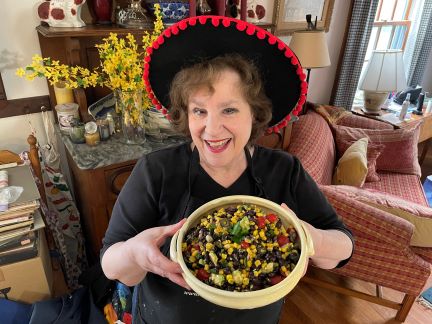
It’s Cinco de Mayo, and I’m making guacamole.
 
My guacamole isn’t original or trendy. But it’s really, really good. It tastes as fresh as can be. And really what more do you need in guacamole?
 
It’s a dish the boys in my family enjoy making—and eating.
 
I’m sure most readers know this, but in case jalapeño novices are lurking out there I offer a little warning:
 
BE CAREFUL while chopping the jalapeño. Wear gloves if you can; otherwise, just wash your hands as quickly as you can afterward, and be careful not to touch anything that could encounter any part of your body while chopping. These peppers can sting!
 
Tinky’s Guacamole
 
Ingredients:
 
3 scallions (green onions), white and some green parts, chopped (I’ve also been known to use about 2 tablespoons of finely chopped red onion)
1 large garlic clove, peeled and minced
1 small jalapeño pepper (more if you like spicy foods!), with the stem and seeds removed, finely chopped
1 small ripe tomato (optional—only use it if in season), cored and chunked
5 sprigs fresh cilantro, roughly chopped
the juice of 2 limes
3 small, ripe avocados
1 teaspoon salt
 
Instructions:
 
In a 1-quart bowl, combine the scallions, garlic, pepper pieces, tomato (if desired), cilantro, and lime juice.
 
At this point, you may leave the mixture for a few hours. About 15 minutes before you want to eat the guacamole, get out your avocados. Slice them in half lengthwise, stopping at the pits.
 
Separate the avocado halves from the pits, and use a spoon or fork to scoop out the flesh of the avocado. (If there is brown flesh, don’t use it; aim for the light green stuff.) Put the flesh in the bowl with the onions, garlic, peppers, tomatoes, cilantro, and lime juice.
 
Mash the avocados into the mixture with a fork, adding the salt as you mash so that it is stirred in. You don’t have to mash them too much; a few chunks add to the flavor.
 
Place the guacamole in a decorative bowl, and serve it with tortilla chips (homemade are the best, but they’re also the most fattening!).
 
Serves 6 to 8.


From left to right: Alan, Michael, and David mash avocados into guacamole.

If you enjoyed this post, please consider taking out an email subscription to my blog. Just click on the link below!

Subscribe to In Our Grandmothers’ Kitchens by Email.