Archive for the ‘Cakes, Pies, and Pastry’ Category

The Power and Passion of Natasha Lowe

Thursday, April 25th, 2013

Poppyweb

I apologize for my recent absence from these pages! I have been working on polishing my forthcoming book, Pulling Taffy, a project that has included recording the audio version of the book.

I’m still working on setting things up for the book so I’m afraid I won’t be posting a lot in the near future. But I CAN offer you this food-related story, which I wrote recently for the Greenfield Recorder.

“Follow your passion” is Poppy Pendle’s motto. Poppy’s creator lives by that motto as well.

A book for young readers (more or less eight to 12 year olds), The Power of Poppy Pendle is only a few months old but has already entered its second printing.

Poppy’s author is the English-born Natasha Lowe, who lives in an 1840 house in Deerfield, Massachusetts, with an entrepreneurial husband, four children, a busy kitchen, and a vibrant imagination.

Natasha’s passion for storytelling—and for life—comes across with gusto in her huge smile and her rapid conversational style. She told me in a recent interview that she inherited her love of narrative from her parents.

“My parents were amazing storytellers. My mum grew up in Lancashire, and she would tell us a story about a witch called Beady Eyes,” said Natasha. “I’ve always had a love of witches—not evil witches but good, fun-loving witches.”

Poppy Pendle is one such witch. The book opens with her birth in a bakery, a location that foreshadows Poppy’s passion. The child Poppy wants nothing more than to be a baker. Unfortunately, her parents detect that she has magical powers and want her to grow up to be a prestigious white witch like her Great-Granny Mabel.

They enroll Poppy in an academy of magic. She excels at charms and spells but would trade them all for a plate of cookies. She flies with grace but would rather wield a rolling pin than a broomstick.

Her parents ignore her protestations that she doesn’t want to be a witch, breaking Poppy’s heart by taking the oven out of their kitchen so that she won’t be distracted from her magical studies by baking projects.

Eventually, Poppy’s frustration and anger, combined with her talent for magic, lead her to go over to “the dark side.” She casts spells that put her at odds with her family, her teachers, and society at large. She must re-find her passion before she can right the wrongs she has done and move forward in life.

Poppy is a charming heroine, with enough spice in her personal recipe to enable boys as well as girls to identify with her. The book’s message of following one’s passion, as Natasha told me, “is one for everyone to hear.”

She added, “And if there’s a message in there for parents, it’s to listen to your children.”

Natasha explained that she has learned the value of listening from her varied children, three boys and a girl, who range in age from nine to 20. “You have to have faith, and you have to trust your kids.”

The lesson also came from her parents, who always had faith in her, she recalled.

She came to this country in her late teens on a student visa, looking for a place to learn creative writing. Fate changed her plans when she met the man she was to marry, and he quickly proposed. “It was one of those crazy, impulsive things,” she recalled.

She worried about the reaction of her parents. After a quick inspection, however, they told her, “He looks great for you. We have always taught you to trust your instincts … so, if it feels right, stay.”

Natasha’s husband had purchased the house on the main street of Historic Deerfield as an investment while he was a senior at Deerfield Academy.

“He showed it to me,” remembered the city-bred Natasha. “I said, ‘It’s absolutely gorgeous. But I’ll never live in the country.’”

The pair fixed the house up as a bed and breakfast and hired someone to run it. When that person was unable to honor the commitment at the last minute, Natasha found herself drafted as the temporary proprietor of the Tea House Bed and Breakfast.

After a year in Deerfield she was hooked. “Going through all the seasons [here], I realized I didn’t want to be anywhere else,” she told me.

The bed and breakfast lasted for about five years, and then, in Natasha’s words, “the guestrooms started filling up with children, and it was hard to offer romantic getaways with toddlers running around underfoot!” The house was a family home rather than a B&B from then on.

Natasha had always been interested in writing and had had a few short stories published in her youth. A few years ago, when her youngest child, Juliette, started kindergarten, Natasha decided that she didn’t want to look back at her life years later with regret.

“If I was going to [be a writer] and take myself seriously, I had to just sit down and start sending stuff out,” she said. “I was really lucky. I got a wonderful agent quite quickly. She’s been in the children’s writing field for many, many years.”

Despite this luck, it took a few years and a few rewrites before The Power of Poppy Pendle made its way to Simon & Schuster, where esteemed children’s book editor Paula Wiseman fell in love with the book.

Wiseman’s main request was one that fit perfectly with Natasha Lowe’s vision of the book. She asked whether the author would consider adding some of Poppy’s recipes as an appendix.

Natasha launched herself into recipe testing (she admitted that she tried so many batches of lemon bars that today one of her sons refuses to eat them), and the final book now offers ten tempting recipes, including the cupcake recipe below.

I asked Natasha about the origins of Poppy’s story. She explained that it all began with a stone goose her husband brought home one day from an auction and placed in the garden. “It does look really, really real,” said Natasha.

Her then four-year-old daughter Juliette wanted an explanation for the goose’s surprised expression.

“I said maybe a witch had put a spell on it,” her mother explained.

Of course, Juliette wanted to know about the witch … and on the spot Natasha came up with the story of a young witch who was upset because she wanted to be a baker, not a witch.

“Suddenly, I knew I had to write that story,” recalled Natasha. “It was almost given to me fully formed. I actually raced inside and started working at my computer.”

Today Natasha is enjoying the task of publicizing her book—talking to children, adults, and even seniors about Poppy Pendle. She is also working on several new writing projects. “I’m never short of ideas!” she told me with a smile.

Natasha Loweweb

Poppy Pendle’s Coffee Cup Cakes

Courtesy of Natasha Lowe

Poppy Pendle dreamed up these delicious treats after drinking her first cup of French brewed coffee at her favorite bakery. Natasha told me that in England a “coffee cake” is a cake flavored with coffee rather than something to accompany a hot beverage.

Ingredients:

1 tablespoon milk
1 tablespoon espresso powder
1/2 cup (1 stick) softened butter
1/2 cup sugar
2 large eggs
1 teaspoon vanilla extract
3/4 cup plus 2 tablespoons self-rising flour (or you can use regular flour and 1-1/4 teaspoons of baking powder and mix them well before adding to the batter)
1/4 teaspoon salt

Instructions:

Preheat the oven to 350 degrees.

Put the milk into a little dish (a small china ramekin is ideal) and warm it in the microwave for about ten seconds. If you don’t have a microwave, just warm some milk gently in a saucepan and measure out 1 tablespoon into a little dish. Sprinkle the espresso powder over the milk, and stir to blend.

If there is a food processor in your home, ask an adult to help you set it up and whiz all the cake ingredients together, including the espresso-flavored milk. Then go to the pouring and baking step.

Otherwise, put your stick of softened butter into a large bowl, and, using a hand-held mixer, whiz the butter around until it is nice and fluffy. Pour the sugar on top and beat together with the butter until well blended. Go slowly at first because you don’t want sugar flying all over the counter.

Add the eggs, one at a time, beating well after each addition. You can ask an adult to help you with this if you like because you don’t want bits of eggshell in the batter. Add the vanilla extract, then the self-rising flour (or flour and baking powder) and the salt and mix quickly again. You don’t want to over mix the ingredients or your cakes will be tough.

Now, mix the powerful espresso flavored milk into your cake batter, scraping around the little dish to make sure you get it all in. The batter will turn a rich coffee color and smell delicious.

Arrange 12 paper cup-cake wrappers inside a muffin tin or, if you want to make miniature cup cakes, you will need about 36 mini paper wrappers for a mini muffin pan. Fill each cup halfway with cake batter, and bake for 16 to 20 minutes for regular cup cakes, 9 to 14 minutes for minis. You might want to ask an adult to help you get the cakes into and out of the oven. Let cool them on a wire rack.

Makes 12 regular sized cup cakes or about 36 mini cup cakes.

Coffee Frosting

You can make this while the cup cakes are baking.

Ingredients:

2-1/2 tablespoons milk
1-1/2 teaspoons espresso powder
1 stick softened butter
1-1/4 cups confectioner’s sugar
as many chocolate-flavored coffee beans as you have cup cakes

Instructions:

Pour the milk into a tiny dish. Warm the milk in the microwave for about 10 seconds and sprinkle the espresso powder on top. Stir to blend.

Put the softened butter into a large bowl and shake the confectioner’s sugar on top. Using a big wooden spoon or a hand-held mixer (Natasha likes to use a hand-held mixer because it makes the frosting really smooth and creamy), gently stir the espresso flavored milk into the mixture, and blend together until soft and creamy.

Go slowly to begin with; otherwise you will have sugar all over your counter! If you want a softer frosting, just add a drop or two more milk.

Using a dinner knife, smooth the frosting on top of the cup cakes and decorate with a coffee-flavored chocolate bean.

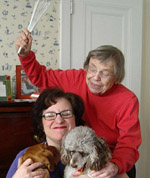
Just for fun, here's a look at my homemade recording studio.....

Just for fun, here’s a look at my homemade recording studio…..

End of Season Peach Cobbler

Monday, September 10th, 2012

Peach season is winding down in our corner of Massachusetts. I’ll miss it, but apples are on their way!

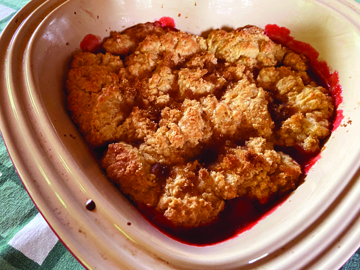
I have made this cobbler a couple of times in the past few weeks with juicy local peaches. Once I used peaches alone (the photo at the top of this post, courtesy of my friend Lisa Johnson); once, half blueberries and half peaches (the photo at the bottom).

The dessert is simple to make. It’s even simpler if you make the fruit base the night before and throw things together to bake while you’re eating your main course.

If you love ginger with your peaches, substitute a little of it for the cinnamon. Or just add ginger along with the cinnamon. I love ginger but not necessarily in peaches so I left it out.

The Cobbler

Ingredients:

for the fruit base:

1/2 cup sugar
2 tablespoons cornstarch
4 cups chopped peaches (or half peaches and half blueberries or raspberries)
3 tablespoons lemon juice
1 teaspoon cinnamon
1 tablespoon butter, diced

for the cobbler crust:

1 cup flour
2 tablespoons sugar
1-1/2 teaspoons baking powder
1/4 teaspoon salt
1/4 cup (1/2 stick) butter
1/4 cup milk
1 egg, beaten
1 teaspoon vanilla

for the topping:

2 tablespoons brown sugar

Instructions:

Preheat the oven to 400 degrees. Butter a 1-1/2 quart casserole dish.

Begin by making the base. Combine the sugar and cornstarch in a smallish nonreactive pot. Stir in the fruit and lemon juice.

Bring the mixture to a boil, stirring occasionally. Boil, stirring gently, for 1 minute. Remove the fruit from the heat and stir in the cinnamon.

Spread the fruit n the prepared pan. Dot the top with butter.

To make the crust whisk together the flour, sugar, baking powder, and salt. Cut in the butter, but don’t overdo the process. You should still have tiny pieces of butter in the mixture.

Whisk together the milk, egg, and vanilla. Add them to the dry ingredients, and mix just until moist. Drop the resulting mixture onto the peaches, and spread it around to cover the fruit. Sprinkle brown sugar over all in little clumps.

Bake until lightly browned, 20 to 25 minutes. Serves 8.

Summer Fruit Key-Lime Pie

Friday, August 10th, 2012

I have mentioned before how much I love key-lime juice and key-lime pie. I love being able to buy key-lime juice from Nellie & Joe’s just about anywhere. (No, Nellie and Joe didn’t pay me or give me anything to say that. It’s the plain truth.)

I had a request for key-lime pie a couple of weeks ago. I also had a whole bunch of lovely fresh fruit in the house, including gorgeous tiny blueberries and the first peaches of the season. So I decided to add a little local fruit to my key-lime creation.

The result was an incredibly easy to make (and easy to eat) melding of north and south, sweet and tart.

My camera is broken, but luckily one of my guests, Alison Seaton, brought along her IPhone and took a photo of the pie before it disappeared completely.

The Pie

Ingredients:

for the fruit layer:

2 cups mixed fruit (peaches and blueberries … or peaches and blueberries and raspberries!)
2 tablespoons sugar
2 tablespoons key-lime juice
1/1-2 teaspoons cornstarch

for the key-lime layer:

1/2 cup key-lime juice
1 can (14 ounces) sweetened condensed milk
3 egg yolks

for assembly:

1 uncooked 8- or 9-inch graham cracker crust (I made this from scratch, but store bought will do in a pinch)

for presentation:

whipped cream to taste (optional but good)

Instructions:

This recipe is best prepared several hours in advance.

Combine the fruit, sugar, and 2 tablespoons key-lime juice in a nonreactive saucepan. If you have time, let them sit for half an hour or so. Otherwise, forge ahead!

Stir in the cornstarch. Bring the mixture to a boil, stirring constantly, and boil, stirring, for 2 minutes. Remove the saucepan from the heat and set it aside to cool. When it is at room temperature, cover and refrigerate the fruit mixture.

Preheat the oven to 350 degrees. In a bowl whisk together the ingredients for the key-lime layer. Pour them into the pie crust.

Bake the pie for 20 minutes. Remove it from the oven, and let it cool to room temperature; then cover it and place it in the freezer.

About an hour before you are ready to serve your pie, pour the fruit layer on top of the key-lime layer and put the whole thing in the refrigerator until you are ready to serve it.

Serve with whipped cream as desired. Serves 6.

Rhubarb Cobbler

Friday, June 1st, 2012

My little Rhubarb is well named. She wanted to nibble on the rhubarb leaves I brought into the house. I made her settle for toying with a "mouse" made of the stalk.

Susan Shauger, who sings in our church choir, brought a rhubarb cobbler to the church’s recent Meal without Plastic. It was a huge hit.

Of course, I asked for the recipe. Susan explained that she couldn’t find the exact one she used, which was from a vintage cookbook. But … it went something like this!

I have mentioned before on these pages that I adore rhubarb. I have a feeling I’ll be making Susan’s cobbler a lot in rhubarb seasons to come. It’s easy, and the tangy rhubarb flavor sings happily under the biscuit crust. I served it to friends last weekend with homemade vanilla ice cream.

We were VERY happy….

Susan’s Cobbler

Ingredients:

for the rhubarb base:

3/4 cup sugar
2 tablespoons cornstarch
4 cups chopped rhubarb
2 tablespoons lemon juice
1 teaspoon cinnamon
1 tablespoon butter, diced

for the cobbler crust:

1 cup flour
2 tablespoons sugar
1-1/2 teaspoons baking powder
1/4 teaspoon salt
1/4 cup (1/2 stick) butter
1/4 cup milk
1 egg, beaten

for the topping:

2 tablespoons brown sugar

Instructions:

Begin by making the base. Combine the sugar and cornstarch in a smallish nonreactive pot. Stir in the rhubarb and lemon juice. Cover this mixture and let it sit for an hour or two until the rhubarb juices up.

Preheat the oven to 400 degrees. Butter a 1-1/2 quart casserole dish.

Uncover the rhubarb mixture and bring it to a boil, stirring occasionally. Boil, stirring gently, for 1 minute. Remove the fruit from the heat and stir in the cinnamon.

Spread the rhubarb mixture in the prepared pan. Dot the top with butter.

To make the crust whisk together the flour, sugar, baking powder, and salt. Cut in the butter, but don’t overdo the process. You should still have tiny pieces of butter in the mixture.

Whisk together the milk and egg. Add them to the dry ingredients, and mix just until moist. Drop this mixture onto the rhubarb mixture, and spread it around to cover the fruit. Sprinkle brown sugar over all in little clumps.

Bake until lightly browned, 20 to 25 minutes. Serves 8.


If you enjoyed this post, please consider taking out an email subscription to my blog. Just click on the link below!

Subscribe to In Our Grandmothers’ Kitchens by Email.

Domestic Hitchcock: Shadow of a Doubt

Wednesday, May 16th, 2012

Please donate!

This post takes part in the third annual film-preservation blogathon For the Love of Film, hosted by Ferdy on Films, the Self-Styled Siren, and This Island Rod.

This year’s blogathon is devoted to the work of Alfred Hitchcock. Funds raised will help the National Film Preservation Foundation stream an early film on which Hitchcock worked, The White Shadow, on the internet for several months—and record a new score for this silent film. Please click on the photo above to donate to this worthy cause. Films are perishable, and they need our help!

Now, on to MY Hitchcock contribution……

Joseph Cotten, Teresa Wright, and Patricia Collinge in "Shadow of a Doubt"

As a food writer I often find it difficult to write about films, particularly films like those of Hitchcock, in which action and suspense are key. The characters have little time for cooking and eating. So for this essay I turn to Hitchcock’s most domestic motion picture—some might say his ONLY domestic motion picture—Shadow of a Doubt.

Released in 1943, Shadow of a Doubt has long been one of my favorite Hitchcock films in large part because it is domestic. The house in which most of the action is set is almost a character in the story. Viewers get to know its hallways, doorways, and rooms. And many plot points are worked out at the dinner table.

Since Shadow is a Hitchcock film the domesticity it explores is dark. It is domesticity nonetheless, however, and the picture features sympathetic and complex female characters.

Indeed, the film is primarily experienced through one of those characters, Young Charlie (Teresa Wright). A recent high-school graduate who still lives with her family in an old-fashioned home in Santa Rosa, California, Charlie is restless.

She finds family life tedious and is particularly concerned with that life’s effect on her mother Emma, who seems to spend her days going from one dispiriting household task to another. Charlie senses that she and her mother are trapped. “All I’m waiting for now is a miracle,” she tells her kindly but weak father Joe (Henry Travers).

The miracle comes almost immediately in the form of a prospective visit from her mother’s brother Charlie (the handsome, velvet-voiced Joseph Cotten), after whom young Charlie was named. The namesake feels a special kinship with her uncle, a far-off glamorous figure who sends wonderful presents but rarely shows his face in Santa Rosa.

The family gathers around Uncle Charlie at the dinner table.

Charlie believes she has a psychic bond with Uncle Charlie, a bond Hitchcock famously emphasized from the start of the picture by introducing both Charlies in the same position—lying on a bed looking despondent.

Charlie is even happier when she sees the effect the news of her uncle’s imminent arrival has on her mother Emma (Patricia Collinge). Emma’s voice lifts and her face lights up as she speaks of her long-ago childhood with Uncle Charlie, the spoiled baby of her family.

Uncle Charlie’s arrival is all that Young Charlie and Emma have hoped for. He brings laughter to the house and showers his relatives with gifts. Almost immediately, however, Charlie begins to wonder about her uncle. He has isolated moments of scary violence. He is trying to hide something. And the gorgeous emerald ring he gives her is inscribed with the initials of a dead woman.

Young Charlie begins to feel uncomfortable with Uncle Charlie. Papa Joe looks on at right.

Hitchcock brought in Thornton Wilder to work on the screenplay for Shadow. The film was shot on location in Santa Rosa, an attractive, medium-sized town, and the director believed that the playwright of Our Town could add a certain authenticity to this story of America’s heartland.

He did—as did the brilliant cast. Shadow of a Doubt both celebrates and critiques small-town life—and middle-class American life in general.

Like Uncle Charlie, the town of Santa Rosa is beautiful yet contains dark corners.

Like Uncle Charlie, Young Charlie and her mother Emma love the idea of home but long for something more stimulating and ultimately more dangerous.

At the end of the film Young Charlie’s future appears almost as bleak as it does at the beginning. She has survived attempts on her life. Yet she appears doomed to marry the stolid MacDonald Carey and recreate her mother’s humdrum housewifery.

As for Uncle Charlie, he feels forced by fate/fear/insanity to try to kill Young Charlie, whom he really does love.

Perhaps the saddest of the three is Emma. Young Charlie’s mother is devastated when she learns near the end of the picture that her brother plans to leave Santa Rosa, although she is fortunately unaware that he is leaving because he will be arrested or killed if he stays.

“But I can’t bear it if you go, Charles,” she says in near despair. She adds to her guests but most of all to herself, “We were so close growing up, and then Charles went away, and I got married, and you know how it is. You sort of forget you’re you. You’re your husband’s wife……”

Her tearful speech underlines the film’s unsettling portrait of domesticity. Domestic life, Hitchcock and Thornton Wilder tell us, is full of longings, regrets, and even danger. (Young Charlie barely survives two attempts on her life that use the house and its contents as weapons.)

And yet, as Young Charlie learns, Americans in the 1940s, particularly American women, don’t have a lot of other options.

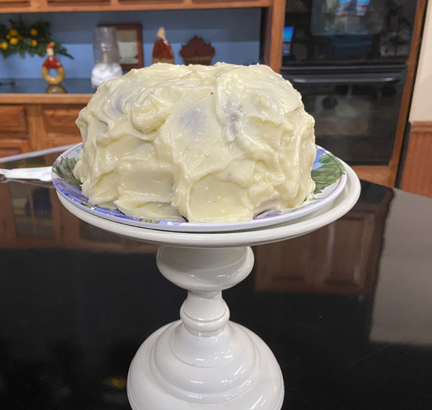
The little cow sprinkles are meant to evoke black-and-white film--and to hide my icing errors!

Emma’s Butterscotch Pound Cake with Maple Icing

Emma and Charlie prepare several meals in Shadow of a Doubt. The food to which the most detail is devoted is a cake Emma demonstrates making for two men who pretend to be conducting a survey about typical American families. They are in reality detectives hard on the trail of Uncle Charlie, whom they suspect of being a serial killer.

She informs the pair that this maple cake is a favorite of her brother Charles. Viewers don’t get to see the entire baking process, but Emma makes it clear that the instructions include creaming butter and sugar and then adding eggs.

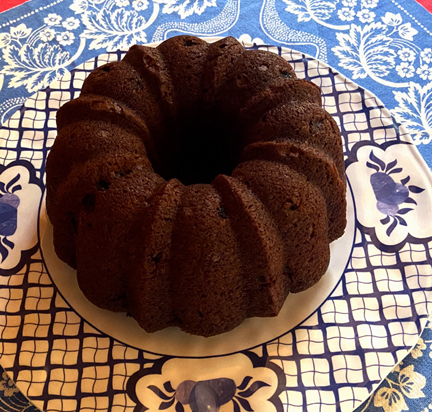
I hope her cake would have tasted something like this dense, rich pound cake with a maple topping. It’s enough to make almost anyone—maybe even Hitchcock—feel more positive about domesticity.

Ingredients:

for the cake:

1 cup (2 sticks) sweet butter, at room temperature
1-1/2 cups brown sugar, firmly packed
4 eggs
2 teaspoons vanilla
1 teaspoon baking powder
1/2 teaspoon salt
3 cups flour

for the icing:

1 cup (2 sticks) sweet butter, at room temperature
3 tablespoons maple syrup
confectioner’s sugar as needed

Instructions:

Preheat the oven to 325 degrees. Lightly grease and flour a 10-inch Bundt pan.

In a mixer cream the butter. Add the brown sugar, and beat until smooth. Beat in the eggs, one at a time, followed by the vanilla. Beat in the baking powder and salt.

On a low speed, blend in the flour until it is incorporated. Transfer the batter to the prepared pan. Bake for 45 minutes to an hour, or until a toothpick inserted into the cake comes out clean.

Set the pan on a wire rack to cool for 15 minutes. Then turn the cake out onto the rack and let it cool completely before making your icing.

Whip the butter for the icing until fluffy; then beat in the maple syrup and sugar. You will need enough sugar to make the icing spreadable but not enough to make it too sweet; start with 1 cup and then add a little at a time as needed.

Serves 8 to 10.

Emma gets ready to bake her cake.

If you enjoyed this post, please consider taking out an email subscription to my blog. Just click on the link below!

Subscribe to In Our Grandmothers’ Kitchens by Email.